
Contents
- The Big Idea: Why This Matters Now
- The Problem You're Solving
- The Hybrid Model: How It Works
- The Time-of-Day Split
- The Four Quadrants: Who You're Reaching
- Content Landscape: What's Available Now
- Hardware and Tech Stack
- The Economics: Revenue Share, CapEx, and Margins
- Operations: How to Run It Day-to-Day
- Marketing Stack: How to Sell Tickets
- Licensing and Contracts
- Common Mistakes to Avoid
- Step-by-Step: Getting Started in 30 Days
- Resources and Contacts
- Q&A Highlights from the AMA
01
The Big Idea: Why This Matters Now
For 10 years, VR arcade operators have been searching for a business model that reliably scales. The hardware kept improving, the experiences got better, but the fundamental economics stayed tight: 80% of revenue crammed into 20% of operating hours, high customer acquisition costs, and an audience ceiling capped at young male gamers and birthday parties.
The breakthrough is a hybrid model that combines gaming (your existing business) with cultural/storytelling free-roam VR content, running in the same physical arenas, at different times of day, reaching entirely new audiences who would never set foot in a VR arcade.
The Gate VR in Paris added Eclipso's Titanic experience to their existing gaming arenas. Result: 20-25% revenue uplift, 2,000 tickets/month at €30 each, zero cannibalization of their gaming business. The cultural audience arrives during dead daytime hours.
The model is proven in Paris, validated by Eclipso across 14 venues globally, and Fever (the world's largest immersive experience ticketing platform) saw the data and invested its own capital to open 12+ dedicated venues. When the company that has all the ticket data bets its own money, pay attention.
This guide walks you through how to implement it: what content to license, what hardware you need, how the economics work, how to schedule and market it, and what to watch out for.
02
The Problem You're Solving
Most VR arcades are stuck in three ways:
Problem 1: You're marketing a technology instead of an experience. "VR Arcade" tells people what tool they'll use rather than what they'll experience. It's like marketing a cinema as a "Projector Building." You're making the customer do the work of imagining why they should care. The VR-skeptic public (which is most adults) won't click on it.
Problem 2: Your audience ceiling is low. Gaming content skews toward 15-34, predominantly male, and is concentrated on evenings and weekends. That means huge blocks of weekday daytime hours sit empty while you're paying rent. Corporate groups and birthday parties help, but they're episodic. The 50-year-old woman who loves history and culture is never going to walk into a VR arcade. But she will buy a ticket to "Immersive Titanic."
Problem 3: Content goes stale. Most operators set up once and stand still. No new content means no new reason to visit. Repeat visitation comes from content, never from the concept ("VR arcade"). Think cinema: nobody goes to see "the cinema." They go to see the new release. Your venue needs to operate the same way.
"Repeat visitation doesn't come from concept. It comes from content. If you stand still, you're dying."
Bob Cooney
03
The Hybrid Model: How It Works
The hybrid model runs two types of content in the same physical arenas at different times of day:
How the storytelling mode operates: It works like a haunted house from a throughput standpoint, not like a session-based arcade game. There's a constant flow of people. You hand them a headset, they walk in, they come out, you wipe it down, and hand it to the next person. No briefing sessions. No controller tutorials. Hand tracking only. One or two staff members can manage the flow.
In 2,000 sq ft, you can accommodate 40-50 people at once. For a 30-minute experience, that's approximately 100 people per hour. At $30/ticket, that's a theoretical throughput of $3,000/hour.
The innovation that makes this possible is redirected walking. Guests feel like they're walking through huge environments (inside a pyramid, across the Titanic deck), but they're walking in circles within your arena. This is why 700-2,000 sq ft of physical space can deliver a 45-minute walking experience.
04
The Time-of-Day Split
The cultural/storytelling audience and the gaming audience arrive at completely different times. There is zero cannibalization.
You must track profitability PSF/Hour to optimize your program on weekends. This means tracking CAC (customer acquisition cost), labor, rent, and licensing costs. If you are not tracking this, you can't optimize your business.
Museums close at 4-5pm. Cultural VR follows the same pattern. Eclipso's Manhattan venue closes at 7 pm on Fridays. In the city that never sleeps. Your gaming business owns the weekend evenings. Birthday parties want daytime slots on Saturday and Sunday. Corporate events on weekday evenings.
"The cultural public they receive is definitely the public that didn't know their venue existed. Absolutely no cannibalization."
The Gate VR, Paris
05
The Four Quadrants: Who You're Reaching
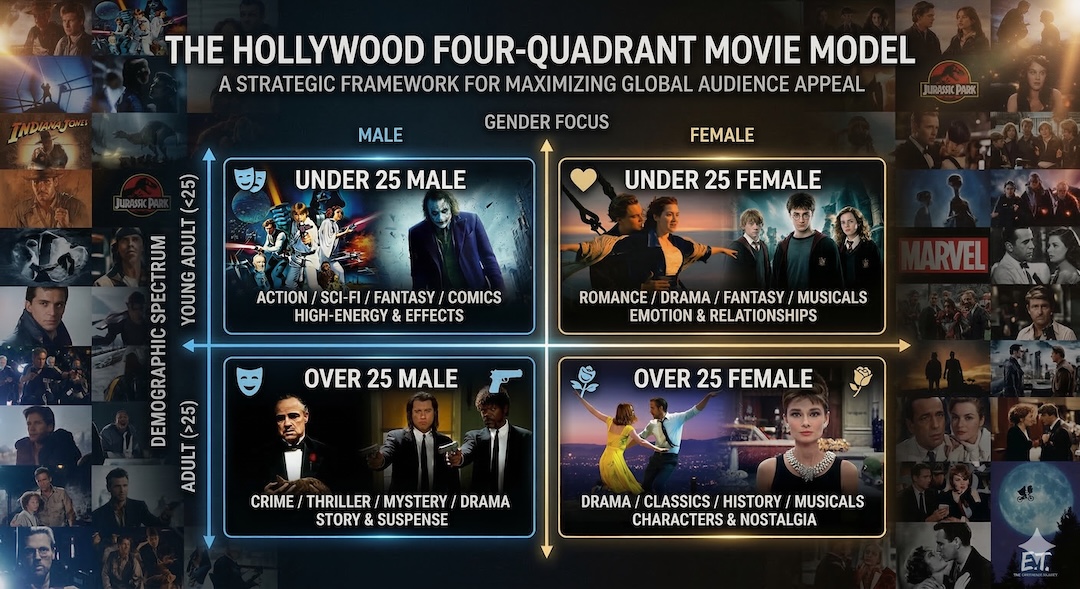
Four Quadrant Hollywood Model.
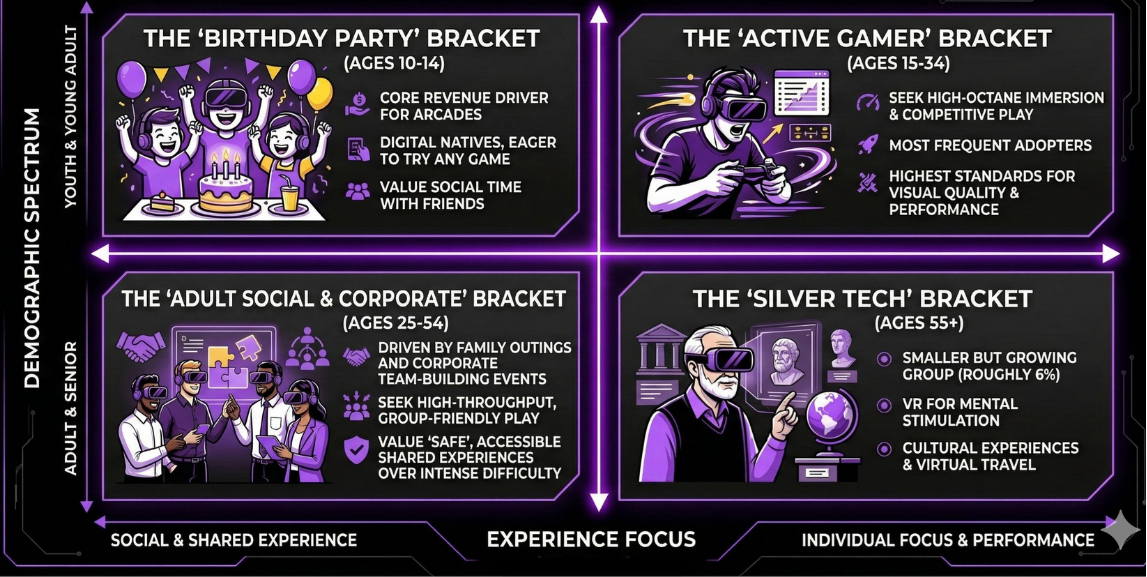
Hollywood uses a "four-quadrant" framework (male/female, over/under 25) to predict blockbusters. Movies that hit all four quadrants do billions. The LBE VR version looks like this:
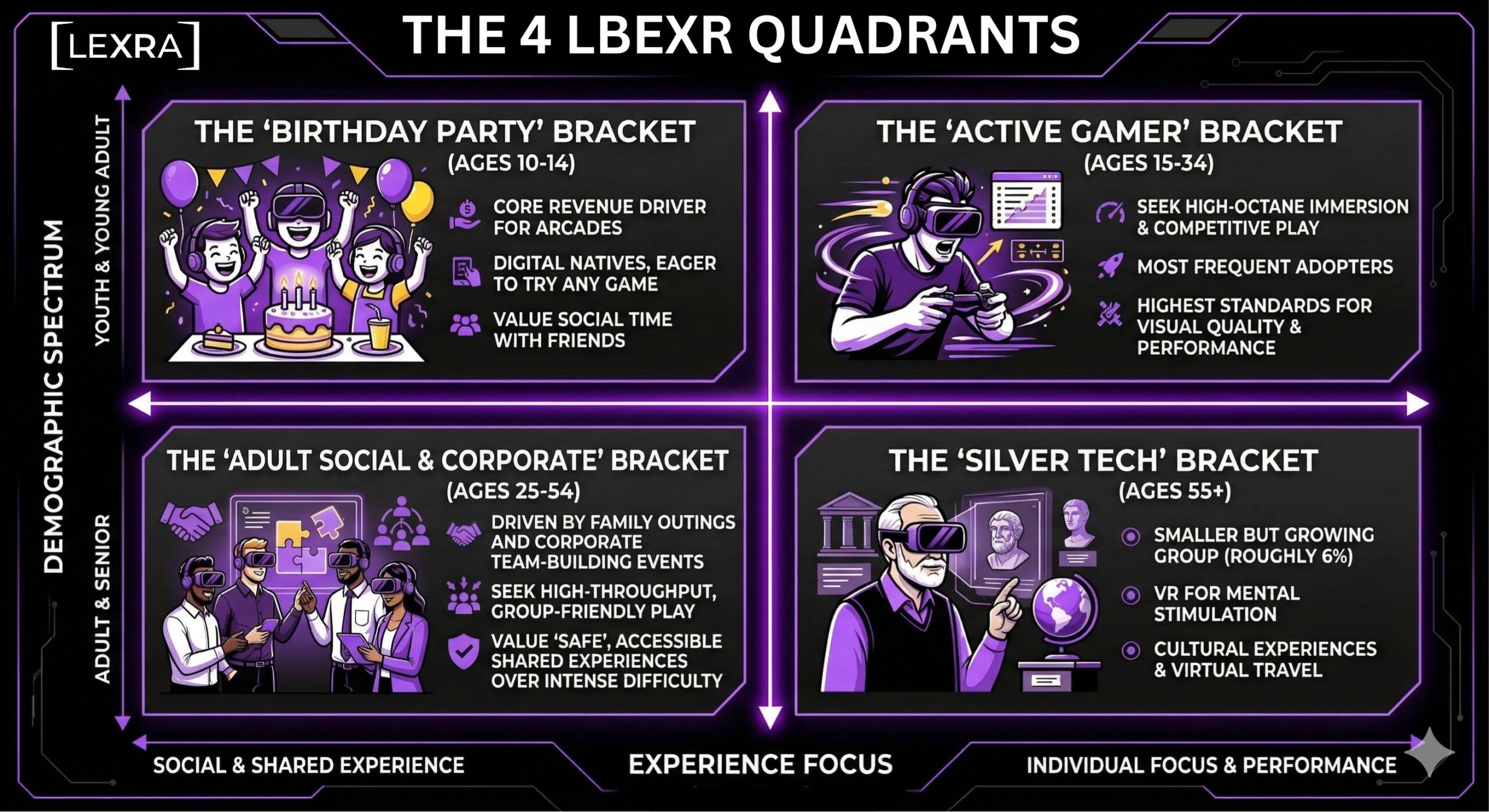
The 4 LBEXR quadrants.
The storytelling/cultural model activates quadrants 3 and 4, the audiences you're currently missing entirely. The primary persona for cultural VR is a 50-year-old woman. She brings her family. She brings her friends. Tourist groups book in bulk. These people would never search for "VR arcade," but they will search for "Titanic experience" or "immersive Egypt."
A fifth segment, education and school groups, doesn't fit the four-quadrant model because it requires a completely different go-to-market approach (long sales cycle, selling directly to schools). Covered separately in section 6.
06
Content Landscape: What's Available Now
The content pipeline is growing. Here's what's available or coming soon, by provider:
Eclipso (Small Creative platform)
Eclipso is the proven hybrid model operator and the most accessible entry point for arcade operators. CEO Antoine Leotaud has joined LEXRA and has given permission to share data openly. He's actively looking for arcade partners and is ready to do installs.
Univrse (Barcelona)
Has been a client of Bob's and is still trying to figure out how to navigate this space. More conservative, and currently have a tiger by the tail with their Black Mirror experience, which just won an award at Cannes Immersive.
Wevr (Los Angeles)
Warner Bros. is an investor. The studio is on the Warner lot in Burbank. They did the Harry Potter VR pop-up for Dreamscape/Warner in New York. Deep Hollywood relationships.
Education Content (LEXRA Members)
Two LEXRA members have created education content with NASA and the ISS:
- VR Core (Jason Van Heerden), available in LEXRA Circle
- Adventure Portal (Braden Clark), available in LEXRA Circle
Education is a different go-to-market. Long sales cycle, selling to school administrators. Don't mix it into your consumer marketing. Treat it as a separate revenue stream with its own strategy.
Indie Developers
Glytch Studios, a LEXRA member, is developing a Viking experience launching in London, running on Spawnpoint as its operational platform. There are others. The content pipeline is growing as more developers enter the space.
07
Hardware and Tech Stack
One of the biggest advantages of the storytelling model: it's standalone, not PCVR streaming. The content runs natively on the headset. No gaming PCs, no streaming infrastructure, no latency issues.
Recommended hardware: PICO
Both Eclipso and Univrse are optimizing for PICO. The reasons are straightforward: a more powerful processor for the price, better standalone performance, and significantly lower cost than alternatives.
Total CapEx: approximately $15,000-$22,000. You could make this back in 1-2 weeks of operation at full throughput.
Multiple APKs on the same headset
All content providers have confirmed that you can have multiple APKs (apps) on the same headsets. You switch platforms when you switch content. So your Hero Zone games, Titanic, BodyVerse, and Colosseum can all live on the same fleet of PICO headsets.
This has been confirmed by content providers but not yet fully tested by operators in the field. Verify this with your specific content providers before purchasing.
Multi-title simultaneous play
Some platforms can already run multiple titles in the same physical space at the same time: half your guests doing Titanic, half doing Colosseum. This feature is available now on some platforms and will be standard across all by the end of 2026. Be mindful of audio bleed: don't mix a quiet art contemplation with a horror experience where people are screaming.
HTC vs. PICO
Some of Wevr's content is HTC-exclusive because VIVE Arts funded its development. They're porting The Little Prince to PICO now, and The Blue will be PICO-compatible on launch. Check with your software providers about which headsets they currently support and what their roadmaps are. And whatever you do, don't use Quest for free roam. Your labor rate will skyrocket (sorry Meta.)
08
The Economics: Revenue Share, CapEx, and Margins
Revenue share tiers
The margin math
Here's the back-of-napkin economics for the storytelling add-on using the Eclipso model:
If you're running 10-15% bottom line on your gaming business and you add 20-25% incremental revenue with 50% contribution margin, you roughly double your bottom line. But watch the CAC.
The Gate VR case study (Paris)
Three 10m x 10m arenas, previously running Veronia gaming content only. Added Eclipso's Titanic 3 months ago. Now selling 2,000 cultural tickets/month at €30 each (€60,000/month incremental). Gaming revenue unchanged: different day parts, different audience. They tried a Louvre experience that underperformed, confirming that title selection matters. Titanic consistently outperforms everything else. IP matters.
Excurio reference data
Excurio (the original creators of Horizons of Khufu) has sold 2 million+ tickets globally at an average of €30 per ticket, over €60 million in revenue from a touring VR property. Google reviews across their venues average 4.8-4.9 stars. Their learnings: Pyramids and Titanic consistently outperform niche cultural content (their Impressionist and Carcassonne titles underperformed). They're returning to Egyptian content for their next title.
LEXRA has published a Google Sheets financial model for this business. Find it in Circle under "Free-roam storytelling business planning tool." Copy it and plug in your own numbers.
09
Operations: How to Run It Day-to-Day
Staffing
The cultural content is simpler to operate than gaming. No controllers to explain, no briefing sessions, no team organization. One staff member handles the flow: scan headset, place on the guest's head, guest walks in. The guest comes out, take headset, wipes down, hands to the next person. That's it.
For daytime cultural hours, you likely need 1-2 staff depending on throughput. Your existing gaming staff can handle it. No separate team needed.
Space sharing logistics
If you're using the same arena for both gaming and cultural content, you need to manage the switchover. The content lives on the headsets as separate apps. You're switching which app launches. The physical space doesn't change. No set pieces to move, no reconfiguration.
If you run gaming primarily on evenings/weekends and cultural during the day, the natural transition point is mid-afternoon. Build a 30-60 minute buffer between the last cultural session and the first gaming session for cleanup and switching.
If your place looks like a kids' arcade, you'll need to dress up the space for a different audience. This is a hidden cost. Look to The Park in Belgium for a great example.
Ticketing and booking
85% of tickets are sold online. You are an e-commerce company. Your booking system needs to handle:
- Booking a specific experience (Titanic vs. gaming vs. Colosseum) in a specific arena at a specific time
- Locking an arena to a specific content type during a time window
- Allowing additional guests to join that session (continuous flow, not batch)
- Handling multiple content types across multiple arenas if you have them
You Must Own Your Customer Data. Do NOT use a ticketing platform that wants to own your data.
10
Marketing Stack: How to Sell Tickets
Antoine (Eclipso) shared his four-pillar marketing stack. This is what's working across 14 venues:
Pillar 1: PR (primarily for launches)
PR drives SEO and awareness for new location openings and new content launches. Get local press coverage, get listed in "things to do" roundups. This is a burst activity around the launch of new titles, not ongoing.
Pillar 2: Paid digital (Meta/social)
This is your primary ongoing acquisition channel. Meta's new Andromeda algorithm changes how you buy ads: you don't build lookalike audiences or do manual targeting anymore. You create varied, persona-based creative and let the algorithm find your audience.
What this means practically: you need a LOT of creative. Different ads for different personas (the mom planning a family outing, the history buff, the tourist looking for things to do, the corporate event planner). The algorithm tests them all and optimizes.
LEXRA's masterclass on this, the AI-powered ad-creation workflow, is live in Circle for members. Watch it and learn. People (even agencies) are still managing ad sets like it's 2025. It's a waste of money.
Pillar 3: Influencer marketing
This needs to be 12 months a year, not a one-off. Every month there should be influencers coming through your venue. Their content disappears from feeds quickly, different influencers hit different audiences, and the effect compounds.
Types to target: mom/family influencers (they're booking summer experiences at $250-$600/kid), local "things to do" influencers, travel/tourism influencers, tech influencers.
Ask your content providers for free tickets for influencer events. They know it drives revenue, and many will provide them. Build this into your licensing agreement.
Pillar 4: Affiliate marketing
This was a surprise discovery. 12% of Eclipso's sales now come from affiliate marketing through Impact.com. Zero upfront cost. It's revenue share (can be 20-25%), but it's found money. Affiliates place ads in news feeds and blogs. Influencers use affiliate platforms to monetize their links.
The mindset shift is to sell the content instead of the technology. Your ads should promote "Immersive Titanic" rather than "VR Arcade." The IP gets the first click from VR-skeptics. Once they've had a great experience, they open up to non-branded content.
Make sure your agency provides transparent reports on where your media spend is going and the Return on Ad Sales (ROAS) for all digital channels. You cannot measure their performance without that info. Some agencies might try to obfuscate how much of your budget goes to media. Always retain control and visibility over your marketing budget.
Keyword opportunity
Check if anyone is bidding on "[your title] + [your city]" keywords. When Fever opened Titanic in Austin, nobody was bidding on "Titanic Austin." That's free real estate. Move fast on these keywords when you launch a new title.
Oh, and if your agency is wasting your media dollars buying "your business name" on Google, unless competitors are buying them too, they're just puffing up engagement stats. Those people are already looking for you. (Make sure your Google My Business page is tickety boo!)
11
Licensing and Contracts
LEXRA is working on a standard licensing agreement template that all content providers can adopt. The goal: negotiate once instead of 25 times. Here's what to look for:
Revenue share vs. per-play fees. Especially important for emerging markets. Per-play fees in USD don't work when your tickets are $3 in local currency. Per play can work if you're comfortable guaranteeing volume. But be mindful that if you're on a flat-fee content plan and you bring in titles from another platform, your cost basis shifts.
Territorial exclusivity. As of this writing, some companies are open to limited exclusivity during defined windows. You don't want three operators in your city running the same Titanic experience. Get this in writing with clear geographic boundaries and time periods. Be prepared to make minimum guarantees.
Influencer/marketing tickets. Build in a provision for free tickets for influencer events and marketing purposes.
Content rotation windows. Understand the minimum commitment period and what happens when you want to swap in new content.
Platform flexibility. Avoid contracts that lock you into a single platform's ecosystem exclusively. You want to be able to run content from multiple providers on the same headsets.
If you're interested in joining the licensing subcommittee to help write the standard agreement, message Bob through our contact page.
Be cautious with any platform whose terms require exclusivity for your space. You must retain control of your ability to program. No single platform has yet proven it has the content to hit all the markets you need to maximize profitability. Unless, of course, they're willing to pay your rent.
12
Common Mistakes to Avoid
Launching with a weak IP. Don't launch with a niche title nobody's heard of. Start with the biggest IP available. Right now it's Titanic. It's a known IP, proven to convert VR-skeptics, and still drives 60% of box office after 2 years. Build from there.
Going too small on space. 700 sq ft technically works, but there's a point where the quality of the experience diminishes. 2,000 sq ft is the sweet spot. Be cautious going below 1,000 sq ft until you've tested it yourself.
Not owning your customer data. Certain platforms charge 6-7% AND want to own your data. Be careful, especially if they're also a potential competitor.
Not advertising. LBE is down 20-40% across all sectors this year. The operators who are UP have increased their ad spend. If you're not doing paid digital, you're leaving money on the table.
Selling the technology instead of the experience. Your ads should say "Explore the Titanic" rather than "Try our VR arcade."
Signing 30-40% revenue share deals. Do the math. After CAC (20-30%) + labor (10-12%) + rent + 30-40% content share, there's nothing left. Push for 20-25% or walk away until scale brings the rate down unless you have a huge list and your CAC will be below 10%.
Treating content as set-and-forget. You need 4-6 new experiences per year. Every 2-3 months, launch something new. Build a content calendar. Market each launch like a movie premiere.
Ignoring the education market. But also: don't mix it into your consumer strategy. It's a separate sales channel with a different buyer (school administrators), different pricing, and a long sales cycle. Treat it separately.
13
Step-by-Step: Getting Started in 30 Days
Antoine told me you could get a storytelling experience open in a week if you push it. Here's a realistic 30-day plan:
Week 1: Assess and decide
- Check if Fever or any other operator is already running Titanic or similar cultural VR in your market. If not, you have a clear runway.
- Review the LEXRA financial model (Google Sheets in Circle). Plug in your rent, labor costs, and local ticket pricing.
- Identify which arena(s) you'll dedicate to cultural content during daytime hours.
- Contact Antoine at Eclipso through LEXRA Circle, or ask for an introduction through ourcontact page.
Week 2: Contract and hardware
- Negotiate licensing terms. Aim for 20% rev share, territorial exclusivity, and influencer ticket provisions.
- Order headsets if you don't already have compatible hardware (20-30 units). Get one and test it with your current software and content to verify compatibility.
- Set up or verify that your booking/ticketing system can handle time-based experience booking.
- Start building your Google Ads keyword list: "Titanic [your city]", "immersive experience [your city]", etc.
Week 3: Install and test
- Install content on headsets. Test the full guest flow: check-in, headset handoff, experience, checkout.
- Train staff on the continuous-flow model (simpler than gaming, no controller briefings).
- Set up your Meta ad campaigns with persona-based creative, and watch the LEXRA Marketing Masterclass in Circle.
- Set up affiliate marketing (Antoine's venues use Impact.com).
- Brief 3-5 local influencers for a launch event.
Week 4: Launch
- Soft launch with invited influencers and local press.
- Go live with paid digital ads.
- Monitor booking patterns and adjust your daytime schedule based on demand.
- Start planning your second content title (Colosseum/Gladiator is the natural follow-up).
14
Resources and Contacts
Content providers
Case study venues to visit
LEXRA resources
- Financial model: Google Sheets in Circle, search "Free-roam storytelling business planning tool"
- LEXRA membership:lexra.org/membership
- Reach Bob Cooney or Kylie Savage through ourcontact page
- Digital marketing masterclass: live in Circle for members
15
Q&A Highlights from the AMA
Q: Can I use the same PICO headsets for both Hero Zone and storytelling content?
Yes. Multiple APKs can live on the same headsets. You switch platforms when switching content. Not yet fully field-tested by operators, so verify with your specific providers.
Q: What about seated experiences for small arenas?
Bob is skeptical. Seated, passive VR struggles with storytelling because 100% of attention is on the narrative. If the storytelling isn't perfect, you lose them. Free-roam's sense of awe and the act of walking through spaces carry the experience. Seated hasn't produced anything good enough yet. That being said, one of our newest members, Daniel Habib from True3D, has tech to translate mainstream films into 180 3D for VR. He's run successful popups in NYC and is in talks with several operators about licensing.
Q: Does this work in emerging markets (India, Zambia, Southeast Asia)?
It can, but you must negotiate revenue share (not per-play USD fees). Zero Latency has a working location in India. Eclipso just opened in Mumbai (mall pop-up). The key is low labor costs + middle class market + revenue share deals with content providers.
Q: How is the economy impacting business?
LBE is down 20-40% across many sectors. The operators who are up this year have one thing in common: they increased their ad spend. Paid digital is non-negotiable right now.
Q: If you could only pick one title to start with in the US?
Start with the biggest IP available in your market. Right now, that's Titanic. Captures imagination across demographics. Google to see if it's in your market right now. If not, move fast.
Closing
This guide was produced from the LEXRA Member AMA held April 15, 2026. The hybrid gaming + storytelling model is early but proven. The operators who move first will lock up territorial exclusivity in their markets. The content pipeline is growing. The economics work. The question is whether you'll be first in your market or second.
If you're interested in implementing this, message Bob through our contact page. If enough operators commit, LEXRA will negotiate standard terms as a group.
Join LEXRA: lexra.org/membership
Contact: through our contact page
