Time Pavilion, a VR Heritage Museum in Baku’s Old City, Recreates the Streets of 1919
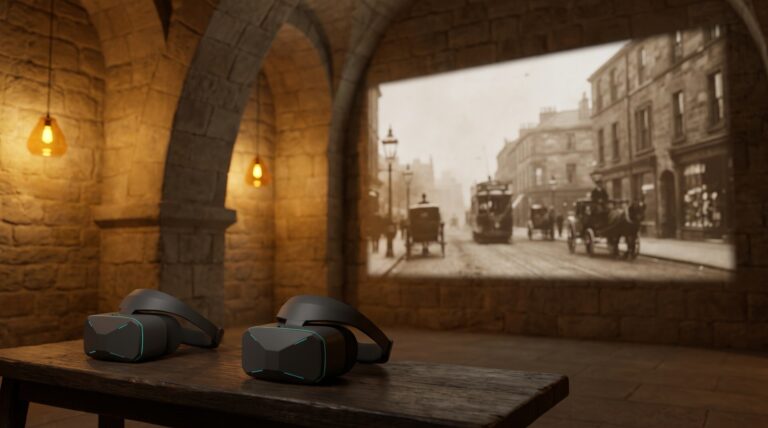
Time Pavilion opened on 19 October 2026 in Icherisheher, Baku's walled old city. Its 40-minute virtual reality visit recreates the…
Read more...
Hero Zone: Where Social VR Meets Real-World Revenue -

UNIVRSE and Small Creative launched LBXR eXchange on 3 September 2026 at the Venice Immersive Market. The joint keynote was titled “LBXR eXchange: Unlocking Interoperability”. It is the second free-roam VR interoperability initiative announced in six weeks, and the third such effort now underway. KDDI and STYLY launched the 25-company Location-Based Experiences Consortium in Japan on 28 July. A third effort is forming in China led by the government’s film bureau.
UNIVRSE and Small Creative describe LBXR eXchange as “an open initiative exploring interoperability across the global Location-Based Extended Reality (LBXR) ecosystem”. Its stated model is the Digital Cinema Package, the file format that lets any studio’s film play on any certified projector. The two founders say the initiative will “explore common technical, operational and business principles that could simplify the distribution and operation of immersive experiences across multiple platforms and venues”. They say it “may progressively welcome additional companies”.
The one named mechanism is an Open Venues Label, “a framework intended to recognize venues committed to interoperability and cross-platform compatibility”. The keynote was billed as introducing a partnership programme and first areas of collaboration.
UNIVRSE operates the XRoam platform. XRoam has powered more than 50 deployments in 14 countries since January 2026. UNIVRSE’s own titles have passed five million visitors in 23 countries. Small Creative runs the OnSite platform. OnSite plays in more than 30 cities with a cumulative 30,000-plus tickets sold a month.

LBEC begins with the building. Its first deliverable is a written specification of what a venue must provide before content can be installed: floor area, ceiling height, power and network. Its 25 members include landlords, banks, rail companies and broadcasters alongside the XR studios. It has set a target of ¥15 billion of content distributed through the consortium by 2030.
LBXR eXchange works from the content platforms. UNIVRSE and Small Creative each ship a runtime, a console and a catalogue.
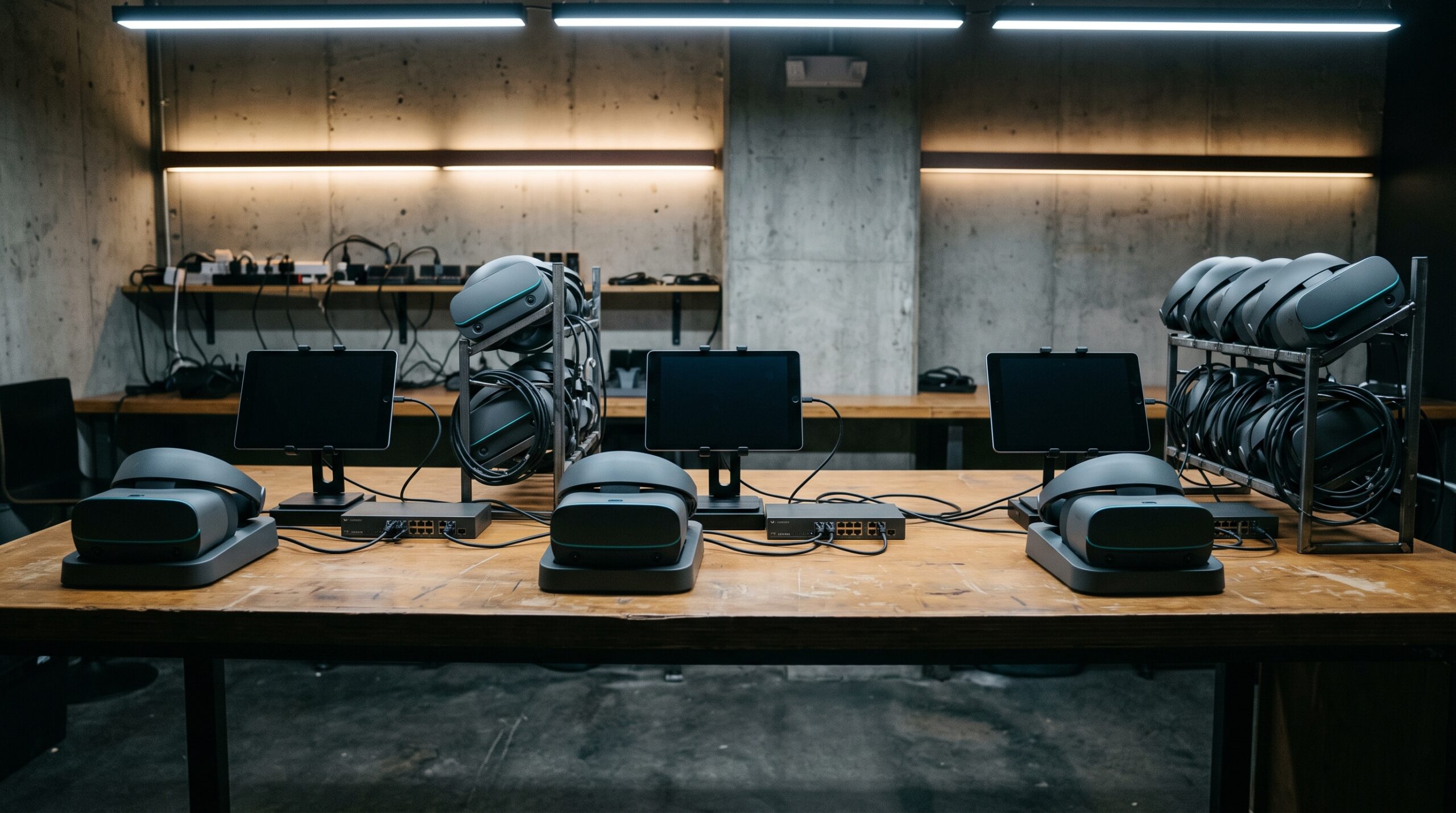
The VR Collective reported on the operator-led effort on 3 August. It starts from the venue floor: the console, headset fleet, check-in and support that a multi-title operator has to run once per platform today.
LBXR eXchange’s founders name the Digital Cinema Package as their model. LBEC’s site goes further: “DCI standardized film, JAMMA standardized games, and ISO standardized the shipping container.”
The Japan Amusement Machinery Manufacturers Association was founded in January 1981. In 1985 it published a wiring standard: a 56-pin edge connector on the game board carrying power, joystick and button inputs, video, audio and the coin mechanism. Before it, Nintendo, Sega, Namco, Atari and the rest each shipped their own harness. A new game usually meant a new dedicated cabinet or a rewiring job.
After it, a cabinet wired to the JAMMA specification accepted a board for any JAMMA-compatible game. An operator swapped a title by swapping the board. A small developer that built to the connector reached every JAMMA cabinet in the world without building a cabinet. The standard came from a manufacturers’ association.
JAMMA carried signals and nothing else. The arcade operator bought the board outright and kept the coin drop. Free-roam VR platforms are paid through a share of ticket revenue.
Seven studios formed Digital Cinema Initiatives (DCI) in March 2002. It published version 1.0 of its specification on 20 July 2005. The first Virtual Print Fee agreements were signed the same year. The fee was paid per booking by distributors toward the exhibitor’s projector, sized to the cost of the 35mm print it replaced.
“JAMMA is the better precedent for this industry than DCI. It drew the line where these three efforts are drawing it: the board stays proprietary, the cabinet becomes common. A trade association wrote it, and the game makers won, because once a board worked in every cabinet they could sell one game to every arcade in the world,” said Bob Cooney, a VR consultant and executive director of LEXRA, the trade association for location-based XR, who began his career operating immersive location-based entertainment in 1989. “The one question JAMMA never had to answer is the money. The arcade operator bought the board. Here the studios take a share of the ticket, and whichever of these efforts survives has to settle that split before it writes anything else.” Cooney publishes The VR Collective; his longer argument on why the standard should copy JAMMA is on bobcooney.com.
Operators presenting titles from two or more platforms now have three efforts to track: LBEC, LBXR eXchange and one emerging from China. LBEC has promised the first written document, its venue guidelines; LBXR eXchange has named a label and a partnership program.
An open industry initiative launched by UNIVRSE and Small Creative on 3 September 2026 at Venice Immersive to explore interoperability across location-based XR, modelled on the Digital Cinema Package.
A framework proposed within LBXR eXchange to recognise venues committed to interoperability and cross-platform compatibility.
LBEC is a 25-company Japanese consortium run by KDDI and STYLY that starts with venue specifications (floor area, ceiling height, power, network). LBXR eXchange is founded by two content platforms and starts with shared principles and a venue label.
A 1985 arcade wiring standard from the Japan Amusement Machinery Manufacturers Association. Its 56-pin edge connector let any JAMMA cabinet run any JAMMA game board, so operators swapped titles by swapping boards.
In the DCI precedent, distributors paid toward the exhibitor’s projector. Free-roam platforms earn a share of ticket revenue. Cooney said whichever effort survives has to settle that split before it writes anything else.