
01
A new format of entertainment
Location-based XR is virtual, mixed and augmented reality in the places where people pay to step into a headset: arcades, free-roam arenas, attractions and museums. The industry calls it LBE XR, for location-based entertainment XR. It sits inside the wider attractions business, next to escape rooms, family entertainment centers and immersive exhibitions.
"It's cool to think that we are at the birth of a new format of entertainment," says Leland Hedges, then General Manager of PICO XR's enterprise business in Europe, who has spent eight years across consumer, content and enterprise XR.
In Japan, VRARRI founder Taiga Kobayashi points to two venues. "Our content at Tokyo Dome City did about 90,000 plays in a year. The other big success is Horizon of Khufu: 120,000 people in a year, and they're opening a second location. Because everybody sees those successes, a lot of companies and operators are interested in starting new locations."
The cost of entry has collapsed at the same time. Brent Bushnell, co-founder of DreamPark Immersive and previously of Two Bit Circus, traces the change: in 2018 a quality VR experience needed a $2,000 computer, cables and a $2,000 tethered headset per guest, and today one hand-tracked standalone headset does all of it. "Spend $1,000, $5,000 on headsets and you're done," he says. "Just get to market."
The suppliers changed with the cost structure. "Standalone headsets with inside-out tracking became the standard. Backpack PCs evaporated from the supply chain," writes Bob Cooney, a VR consultant and executive director of LEXRA, who began his career operating immersive location-based entertainment in 1989. "The cost structure of arena-scale dropped drastically, which is why the category has more entrants now than it did then, even though most of the original names are gone." Cooney publishes The VR Collective; his 2026 revisit of the strategic guide to buying VR attractions holds the longer argument and is quoted through this overview.
What has yet to catch up is public awareness. Amy Hedrick, CEO of headset-hygiene maker Cleanbox Technology, asks industry audiences a simple question. "Do you know what the difference is between VR, AR and MR? The very sad answer was maybe 10% of people in the room at any given time actually knew the answer." If people inside the industry struggle with the vocabulary, a newcomer researching it from outside faces a harder job. That is the job this overview is for.
02
Why the map matters
The industry sells itself as one thing and operates as several. That is the reason to learn its structure before spending money in it.
"There are at least three different industries operating under the LBE VR label," Cooney writes. "There's the FEC attraction business, which is still about throughput, staffing, and the 4:1 ratio. There's the destination free-roam business, which is about 60-minute experiences, premium pricing, and group bookings. And there's the cultural and IP-driven group experience business, which is closer to a museum exhibit or a touring stage production than an arcade. Different operators, different real estate, different content, different economics. Anyone buying VR for their venue needs to know which of those three businesses they're getting into before they look at the products."
The ecosystem map is how you do that placement, three ways.
1. Place the vendor. The roles a supplier holds tell you what its offer includes, what arrives only inside a bundle, and who else it sells to.
2. Place yourself. Which of the three businesses you are entering decides your real estate, your content and your economics before any product decision.
3. Place the gaps. Role by role, the map shows where the industry is crowded and where it is thin, which matters when picking partners you expect to still exist in five years.
"Just because we can sell tickets doesn't mean we can be profitable. The underlying structure of the business ecosystem has to work for everyone. And right now it doesn't."
Bob Cooney, extra!, the LEXRA newsletter, August 2026
03
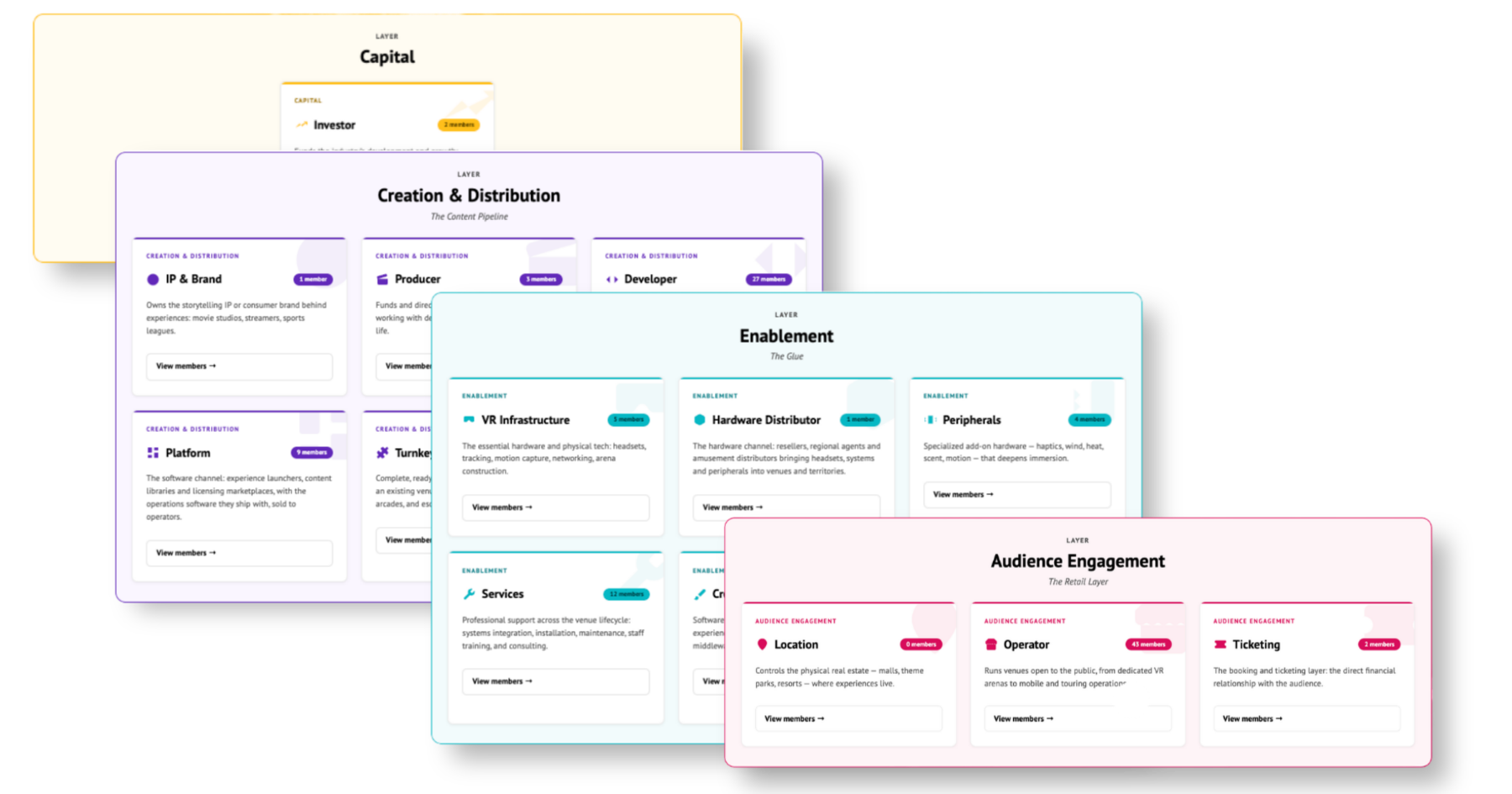
Four layers, sixteen roles
LEXRA, the global association for location-based entertainment XR, classifies every company in the industry with a single framework: four layers, sixteen roles, from capital through creation to the venue where a guest puts on a headset. The interactive version, with live company listings under every role, is the LBE XR Ecosystem Map on The VR Collective.
The four layers:
Capital funds the industry.
Creation & Distribution makes experiences and moves them to venues.
Enablement supplies the technology and services everything runs on, and the channel that gets hardware into venues.
Audience Engagement owns the guest: the real estate, the venue operation and the ticket sale.
One idea makes the whole framework work: a company holds every role it earns, and roles are not exclusive. A company earns a role for each distinct offer it makes to a distinct kind of buyer. Eclipso, the Paris-based free-roam company, funds outside creators to make content, runs the system and content that other venues license, and operates its own venues. Three offers, three buyers, three roles: Producer, Platform and Operator.
The reverse also holds. A capability that can only be bought inside a bundle earns no role of its own. EVA sells the whole business, and its ticketing and its brand travel inside that package, so EVA is a Turnkey Business and an Operator of its own arenas, and nothing else.
Read this way, the map is a diagram of who sells what to whom.
04
The roles, layer by layer
Investor. Funds industry development: venue investments, technology startups, stakes in entertainment chains.
IP & Brand. Licenses storytelling IP or a consumer brand on its own. Movie studios, streamers and sports leagues sit here when their brand travels independently rather than inside someone else's package.
Producer. Pays for and directs the development of experiences. The money flows out, and the counterparty is developers. Eclipso earns this role by funding outside creators to make content for its venues.
Developer. The technical creators who build the games and experiences, from major studios such as Resolution Games to independent teams.
Platform. The software channel that puts experiences in venues: experience launchers, content libraries and licensing marketplaces, together with the operations software they ship with, sold to operators. Content that only ships inside the platform earns no separate role. Pure booking and operations software with no content is Ticketing.
Turnkey Attraction. Sells a complete, ready-to-run attraction that installs inside an existing venue. The buyer already runs a family entertainment center, arcade or escape room and is adding a revenue center. Hero Zone, vrCAVE and RILIX are examples.
Turnkey Business. Sells the whole company: brand, storefront format, full operating stack. The buyer is buying into the industry and may operate nothing today. EVA and Another World are examples, and some companies, Zero Latency among them, sell both ways and hold both roles.
The turnkey split is about the buyer. Buying an attraction means you already run a venue. Buying a business means you are entering the industry. The same product sold both ways earns its seller both roles, and a new operator's first decision is which of these two buyers they are.
VR Infrastructure. The essential hardware and physical technology: headsets, tracking, motion capture, networking, arena construction. HTC, PICO and Cleanbox sit here.
Hardware Distributor. Resells or represents other companies' hardware and systems into venues and territories: amusement distributors, regional agents, value-added resellers. Manufacturers sit under VR Infrastructure. A reseller that also sells integration or deployment separately holds Services as well.
Peripherals. Specialized add-on hardware: haptics, wind, heat, scent, motion seats.
Services. Professional support: systems integration, installation, maintenance, staff training, agencies and consultants. The Rabbit Hole VR's integration business is an example.
Creator Tools. Software and technology sold to creators and developers to build experiences: engines, creation platforms, middleware. Platform serves operators; Creator Tools serves the people making the content.
Academia. Universities and education programs training the industry's next workforce and researching it. Ringling College of Art and Design, a LEXRA member, has students designing in VR through its Virtual Reality Development and Game Art programs, and the membership also includes doctoral researchers specializing in location-based VR.
Location. Controls the physical real estate: malls, theme parks, resorts. The thinnest layer of the map today.
Operator. Runs venues open to the public, including a supplier's own corporate-run sites and mobile or traveling operations.
Ticketing. Sells ticketing and booking on its own. Peek Pro, ROLLER and Fever are examples.
05
Where the money moves
Every dollar in the industry starts with a guest paying a venue. Everything upstream of that moment is business-to-business: operators license content through platforms, buy hardware from manufacturers and their distributors, buy installation and training from services companies, and pay ticketing providers a share of the transaction. Producers fund developers. Investors fund all of it.
When venues do well, everyone upstream gets paid, and benchmark data on the wider attractions industry gives a newcomer a picture of how guests spend. ROLLER's 2026 Attractions Industry Benchmark Report, drawn from its own customer base of attractions venues between July 2023 and June 2025, found that online checkouts made up 33% of bookings but 45% of revenue, with online baskets averaging 3.4 times the in-person point of sale. 84% of online bookings happened on mobile. Members visited 4.9 times a year against 1.3 for non-members, and venues offering parties saw 41% repeat visitation against 26% without.
"I wrote that you can't operate single-player VR profitably with a dedicated attendant, that the 4:1 ratio of players to attendants was the threshold, and that staffing was the make-or-break variable for multiplayer arcade systems. Every operator I've talked to in the years since has confirmed that," Cooney writes. "The staffing model is what separates the products that scale from the ones that struggle."
On pricing, Blaise Whitnish, CEO of Funlab, said it on The VR Collective podcast: "Treat VR like an airplane. Charge top dollar during peak times and deep discounts during off-peak times," with the gaps between dayparts worked through group sales and weekday programming.
The lesson suppliers keep repeating is to prove the unit economics before multiplying them. "The adoption rate is not exponential, so you've got to get the monetization to work at the very first venue," says Hedges. "Scaling something that is net-negative profit just increases how quickly you run out of money. Get one place working to the level of success you need, and then go do the licensing and franchising and expansion."
06
The choices in front of a new operator
There are three ways into the industry, and the ecosystem map's roles line up behind each of them.
1. Buy a business. A Turnkey Business vendor supplies the brand, the format and the operating stack. Fastest route for someone entering from outside.
2. Add an attraction. A Turnkey Attraction vendor installs a ready-to-run product inside a venue you already operate.
3. Assemble it yourself. Content and launcher through a Platform, hardware from VR Infrastructure makers or a Hardware Distributor, Services for integration. Most control, most work.
Whichever route, the operators and suppliers who have already done it keep teaching the same lessons.
Pick your audience before your product
"Know your audience, go narrow, be specific. This is the one I've said a hundred times, and it hasn't gotten less true. The operators winning are the ones who picked a clear audience and built for them," Cooney writes. "If I hear one more operator answer my question, 'Who is your target customer?' with 'Everyone,' I am going to scream," he adds in the same guide.
Match the experience to the trip
"The 45-minute Zero Latency experience is something worth getting in the car for. It's hard to get somebody to put on pants for 15 minutes," Cooney writes. "A 10-minute arcade booth needs to live in a venue people are already at."
Pick the site before the marketing plan
"If you place the location in a good footprint, you don't need to do marketing at all," says Kobayashi, whose VRARRI develops attractions for Tokyo Dome City and runs its own Tokyo venue. "People do not go out for only a one-hour experience. If you want to do standalone location-based VR, you definitely need to place it in a good mall or near a movie theater that has good footfall already."
Offer what home hardware can't
"The first step is making sure you offer something people can't get at home," says Jennifer Poythress, owner of The Rabbit Hole VR in Nashville. "That's why free-roam VR has done so well: the social element, the best content exclusive to commercial licenses, and nobody's going to clear out a space and get six of their friends in headsets at home."
Staff for hospitality
"Pay a little bit more for people who are friendly and can roll with the punches, who aren't just there to punch the clock, because this is your brand," says Bushnell. "The number of times we've had positive reviews because the staff experience was great despite the fact that the tech had broken."
Plan a year of runway
"Look at it like a business and not a hobby," says Poythress. "Assess the market, plan your costs. You can't open and expect to be profitable in three to six months; you need runway for a year, at least."
A lease is no longer the only way to start
"Don't get a lease yet," says Bushnell. "We're now so pop-up and dynamic that you could have an events business bringing really awesome mixed reality to people's events."
And don't research alone
"Tap into the knowledge of all the resources that are at LEXRA and the people that have been in this industry for a while," says Hedrick, "because they can help you continue to have fun with it and not get bogged down in some of the challenges."
07
Where the industry is heading
Consolidation has started
"It's the great consolidation, as we're terming it," says Poythress, whose integration business loads multiple content platforms onto the systems it installs. "Competition between platforms is good for the operator on licensing fees, but we're loading three, four, five content providers onto the VR systems we install. Operationally you just can't have all those platforms that don't talk to each other." Hero Zone bought Spree Interactive's assets in August 2025, then acquired Phenomena that November, folding two compact free-roam product lines into one supplier. In July 2026, Octopod's titles migrated onto the Synthesis VR platform. For an operator, fewer and bigger suppliers mean fewer of the integration headaches Poythress describes, and fewer alternatives when licensing terms change.
Licensed IP keeps moving in
Ubisoft licensed Far Cry to Zero Latency, Hero Zone carries a licensed Terminator title across its network, Netflix licensed Squid Game to Sandbox VR, and Banijay's hour-long Black Mirror Immersive opened in Montreal and now tours internationally. Zero Latency's Jumanji family VR attraction opens December 4, three weeks before Sony's Christmas film. "The operators who differentiated, with deep IP, signature content, or a real brand position, are the ones with pricing power," Cooney writes. The studios are joining the industry's own institutions too: Sony Pictures Entertainment is a LEXRA member, extending its franchises into location-based formats, from Jumanji to its move into Cosm.
The venues are broadening
Immotion built its business inside aquariums, zoos and science museums, a strategy The VR Collective has covered, and its Dolphins of the Reef film won a 2026 Lumiere Award. Museums keep programming XR: Versailles opened a location-based XR attraction for the 250th anniversary of the French-American alliance in 2026, and the Musée Picasso now runs a VR experience on Guernica. And the headset is no longer the only door in. Cosm's LED dome in Detroit opens September 10, 2026 with 19 of its first 21 days programmed, a second dome has topped out in Cleveland, and Sphere Entertainment's venue revenue grew 29% in the second quarter of 2026 even as the segment posted a $69.6 million loss. The VR Collective's directory groups these headset-free shared-space experiences as Immersive Rooms, next to the headset categories.
Studios are crossing over from consumer VR
"The first two, three years we developed consumer VR games for Meta Quest, but it didn't work well," says Kobayashi. "We don't have people using VR headsets daily, especially in Japan." VRARRI moved to venues, and it is one of several studios across Europe and Asia that have made the same move.
The growth is global and uneven
Kobayashi expects "an exponential increase of location-based VR" in Japan on the back of the Tokyo Dome City and Horizon of Khufu numbers. Jim Wyatt, President of RILIX USA and an amusement-industry operator for 21 years, sees the balance differently from the American side: "Having spent time in Europe now, there's more enthusiasm and momentum behind it in Europe."
And the industry is organizing itself
Wyatt spent eight years as president of CEMA, the California Entertainment Machine Association, before joining LEXRA's founding board. "It was very important to California to have connections with lawmakers, to build connections within the industry, to bring people together. The location-based XR community really needs something like that. There's a tremendous opportunity to share. And I think we also need to get in front of any laws that may come up."
08
About LEXRA
LEXRA is the global association for location-based entertainment XR. It grew out of the VR Attraction Summit in Las Vegas in April 2025, where operators, developers and suppliers mapped their biggest shared challenges in an open working session and reached the same conclusion: the industry needed an association. LEXRA launched that quarter. Today it counts more than 100 member companies across 21 countries, 64 in North America, 24 in Europe and 16 in Asia-Pacific. From Dallas to Tokyo, from Brussels to Melbourne.
Membership connects you to the companies named in this overview and the community behind the ecosystem map. Explore membership at lexra.org.
09
Frequently asked questions
What does LBE XR mean?
Location-based entertainment XR: virtual, mixed and augmented reality experiences at commercial venues such as arcades, free-roam arenas, attractions and museums, where guests pay to take part.
What is free-roam VR?
VR in which guests wearing untethered headsets walk freely through a mapped physical arena, usually in groups. It is the largest single category in the LBE XR product directory on The VR Collective.
How is a VR attraction different from VR at home?
Commercial venues offer exclusive commercially licensed content, large tracked spaces and a social, group experience. The operators quoted in this overview build their venues around what home headsets can't do.
How many companies are in the LBE XR industry?
The LBE XR Ecosystem Map on The VR Collective tracks the industry across sixteen roles, and estimates some 5000+ businesses in this space globally.
LEXRA, the association for location-based entertainment XR, more than 110 member companies in 21 countries as of 2026.
What are the three businesses inside LBE VR?
Per Bob Cooney's strategic guide: the FEC attraction business, built on throughput and staffing; the destination free-roam business, built on 60-minute experiences, premium pricing and group bookings; and the cultural and IP-driven group experience business, closer to a museum exhibit or a touring stage production than an arcade. Each has different real estate, content and economics.
